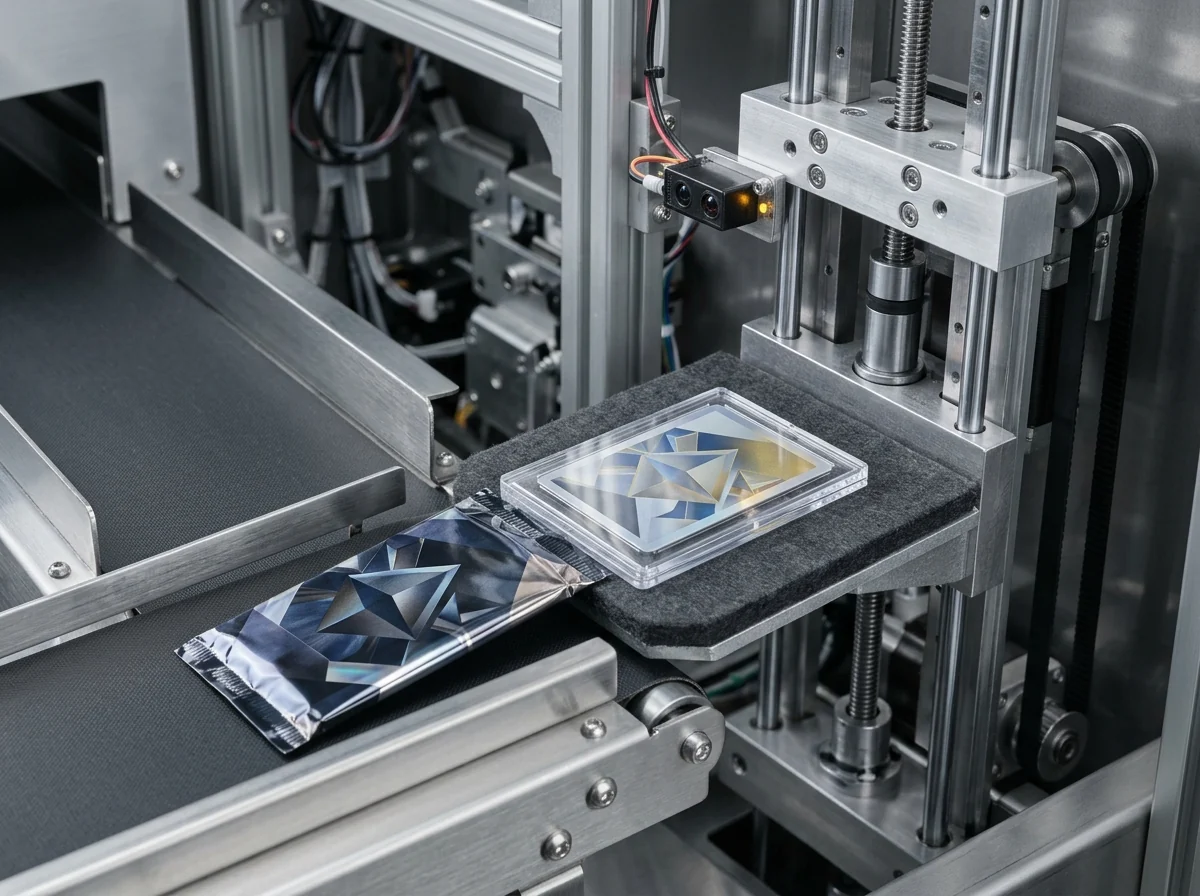
Why Helical Snack Coils Destroy Collectible Card Value
Operators entering automated trading card retail often consider retrofitting a used spiral snack machine to save upfront capital. In practice, standard helical vending coils introduce four mechanical failure modes that rapidly erode collector reputation, damage inventory, and inflate service calls:
- Diagonal Wire Pinch & Corner Dings: Helical metal spirals apply asymmetric rotational shear across the lower corner of a 66 × 118 mm foil booster pack. Thin 6–8 mm packs tilt diagonally between wire loops, creasing foil crimps and bruising card corners before the pack even clears the tray lip.
- Double-Vends & Pack Bridging: When foil wrappers flex under ambient warmth or slight static cling, two thin packs wedge inside a single coil pitch—dispensing two packs for one payment or wedging halfway off the shelf until a customer shakes the cabinet.
- Gravity Free-Fall Shock (600–1,100 mm): Upper trays in a 1.9-meter spiral cabinet drop merchandise roughly a full meter onto a rigid sheet-metal collection bin. Even a 55 g PSA acrylic slab or 78 g BGS holder suffers micro-fractures, corner chips, or cracked sonic welds on impact.
- Missed Drop-Sensor Registration: Legacy flap switches and narrow single-point drop bars calibrated for 50–150 g snack bags routinely fail to detect a 20–26 g foil pack gliding sideways down the chute—causing the controller to spin the coil a second time and dump extra inventory.
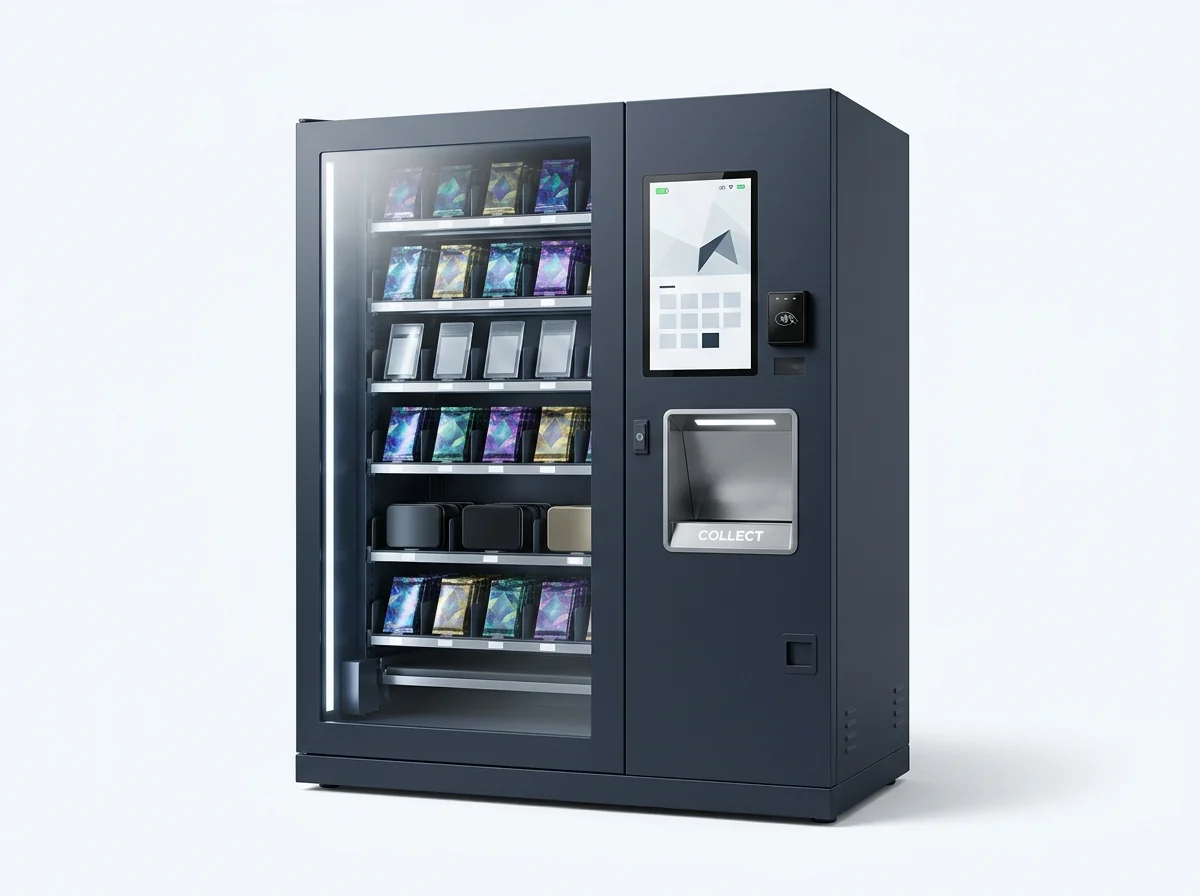
Direct Engineering Comparison: Helical Coil vs. Flat Pusher vs. Belt + Elevator
Every dispensing mechanism trades cabinet depth against unit protection and SKU range. Compare the three commercial architectures side by side:
| Mechanical Parameter | Retrofitted Helical Snack Coil | Flat Pusher + Soft Chute (TCG-WALL-24 / TCG-MINI-16) | Flat Belt / Pusher + Motorized X-Y Elevator (TCG-ELEV-60 / TCG-SLAB-PRO) |
|---|---|---|---|
| Contact Force on Pack | Asymmetric rotational steel wire torque | Centered linear back-face sled travel | Full-base flat belt friction or centered linear pusher |
| Foil Booster Corner Protection | Poor — frequent foil crimp and corner dings | High — zero wire pinch, controlled <420 mm EVA drop | Maximum — zero wire pinch, zero free-fall drop |
| PSA / BGS / CGC Graded Slabs | Unsuitable — high jam and shatter risk | Slim PSA/CGC only in upper short-drop lanes | Purpose-built — smooth shelf-level transfer to padded lift |
| Collector Tins & Sealed Boxes | Unsuitable — exceeds coil diameter & weight | Unsuitable — exceeds slim 300–320 mm cabinet depth | Purpose-built — 110–165 mm brushless belt decks |
| Optical Drop Verification | Legacy flap / basic drop bar misses 20 g packs | Dual-beam infrared curtain across chute throat | Dual-beam infrared curtain mounted directly on lift bucket |
| Lane Format Reconfiguration | Requires purchasing & swapping metal spirals | Tool-free slotted steel divider rails (68–86 mm) | Tool-free slotted divider rails (68–165 mm) |
How Flat Conveyor Belts, Spring Pushers & Cushioned Elevators Eliminate Damage
Straight-Line Force Vector
Whether a lane uses a flat textured PVC conveyor belt (for wide tins, booster boxes, and acrylic slabs) or a spring-loaded straight-line pusher sled (for slim foil booster packs and sleeved singles), every Newton of driving force pushes squarely parallel to the lane divider rails. Nothing twists, pinches, or snags the crimped foil wrapper edges.
Soft-Start Brushless Acceleration for Tall Slabs & Boxes
A tall 136 mm graded slab or upright collector box carries a high center of gravity relative to its 6–10 mm base thickness. Abrupt on/off DC gear motors can topple the next slab backward inside the lane when stopping. Floor kiosks like TCG-SLAB-PRO utilize smooth soft-start/soft-stop brushless belt indexing combined with smooth side guide channels so both the dispensed slab and the waiting stack stay vertical.
Zero-Drop Cushioned Lift Hand-Off
Before any motor advances a lane on TCG-ELEV-60, TCG-SLAB-PRO, or TCG-DOUBLE-BAY, the motorized X-Y elevator bucket travels upward and parks flush with the exact millimeter elevation of the selected shelf lip. The pack or slab glides horizontally onto closed-cell EVA padding, trips the carriage’s dual-beam optical sensor, and rides smoothly down to the waist-height anti-fishing pickup bay.
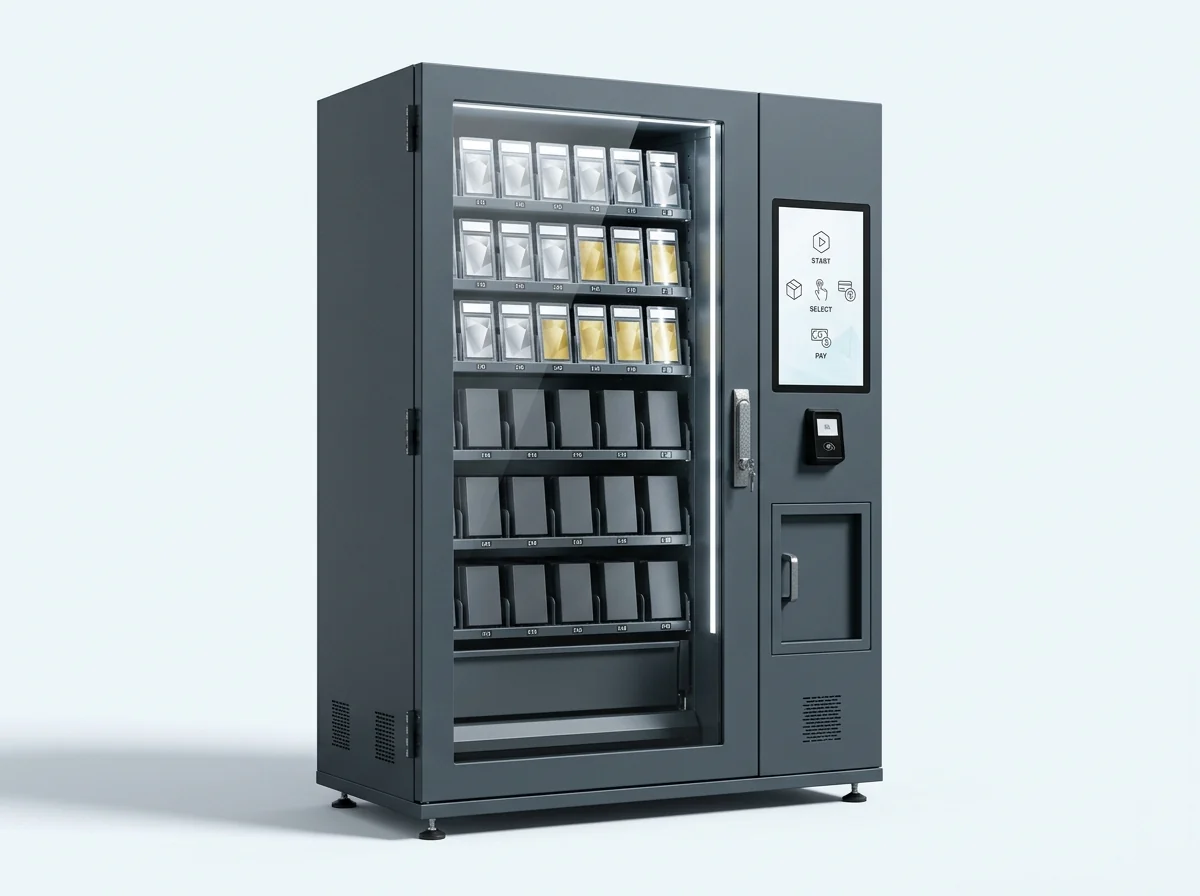
Operational Loading Checklist to Keep Jam Rates Near Zero
Even coil-free hardware performs best when route technicians follow four quick stocking habits during restocks:
- Set 2–3 mm Total Lateral Clearance per Lane: Leave approximately 1–1.5 mm breathing room on each side of the SKU (for example, 69–70 mm lane width for a 66 mm foil booster pack, or 85–87 mm for an 81 mm PSA slab). Tighter rails bind slightly curled foil wrappers; overly wide lanes let thin packs skew sideways.
- Place Rigid Sleeves on Ultra-Floppy Vintage Packs: Standard modern 10-card foil boosters stand upright cleanly in flat pusher rails. Extremely thin vintage 3-card promo packs or loose unsealed singles should be inserted into clear semi-rigid card savers or rigid top-loaders before loading.
- Keep Interior Humidity Inside 45–60% RH: High ambient moisture causes unsealed cardstock and foil wrappers to cup slightly over weeks in coastal venues; specify the optional internal dehumidifier module if placing a cabinet near open exterior doors.
- Run Two Optical Test Vends After Every Lane Resize: Whenever re-indexing divider rails from booster packs to graded slabs, execute two manual service-menu test vends to confirm crisp dual-beam infrared detection and clean shelf-to-elevator transfer.
Verify how lane spacing impacts total stock capacity in the Capacity & Restock Cycle Calculator, explore full elevator specs in Coil-Free Elevator Card Kiosks and Graded Slab Kiosks, or return to Master Technical Specifications.
Standard & Custom-Engineered Models
60-Lane Coil-Free Elevator Trading Card Vending Machine
60-lane floor-standing coil-free elevator vending kiosk (1180×860×1940 mm) with 21.5-inch HD touchscreen, laminated anti-theft glass, infrared drop sensors, and Nayax MDB cashless readiness.